
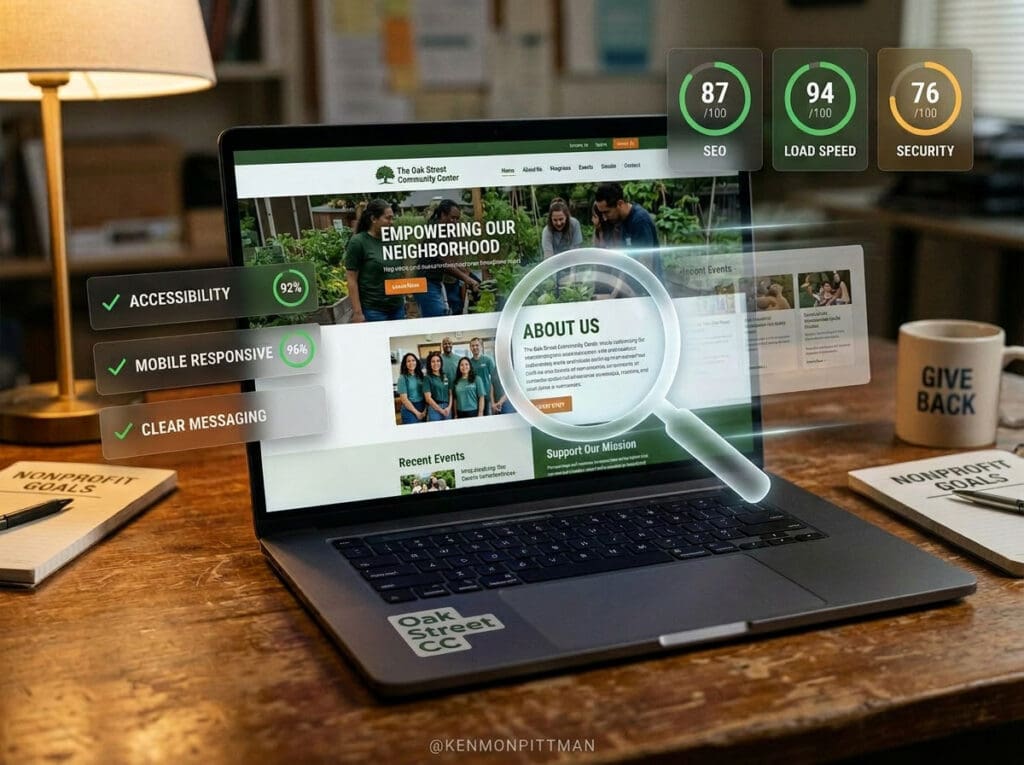
If your website has been on your mind lately, you’re not alone.
Most nonprofit leaders and small business owners I talk to have a feeling that their site isn’t doing what it should. Visitors come in. People look around. Not many reach out or take the next step.
The hard part isn’t knowing something is off. The hard part is knowing where to start.
That’s what a website audit is for.
It’s Not About Finding Broken Things
A lot of people assume a website audit is a technical checkup. Broken links. Slow load times. Code errors.
Those things matter. But they’re not the heart of what an audit looks at.
A website audit is really about seeing your site the way a first-time visitor does. Someone who has never heard of you. Someone who landed on your page and is quietly deciding whether to stay or leave.
The audit asks the questions that visitor is asking. And it shows you where your site is losing them.
The 8 Areas a Website Audit Covers
When I do an audit for a client, I go through their site across 8 specific areas:
Design and UX. Does the page make sense to someone who has never seen it before? Is it easy to use on a phone? Can a visitor find what they need without digging?
Calls to action. Are they clear? Are they placed where visitors actually see them? Do they tell someone what to do next, or do they leave them guessing?
Content and messaging. Does the homepage explain who you serve and what you do within the first few seconds? Or does a visitor have to read three paragraphs to figure it out?
Trust signals. Are there testimonials, credentials, or proof that the work is real? Most visitors are quietly asking, “Can I trust this?” before they ever reach out.
SEO basics. Can people find the site in the first place? Are page titles and descriptions doing their job in search results?
Tracking and analytics. Is Google Analytics installed? Do you know how visitors are behaving on the site, or are you working without that information?
Technical health. Is the site loading at a reasonable speed? Are there errors visitors might be hitting without you knowing?
Industry-specific checks. For nonprofits, this means looking at whether donation prompts, volunteer calls, and impact proof are showing up in the right places. For small businesses, it means checking whether the service offering is clear and the contact path is easy.
Each of these areas gets a real score. Not a gut feeling. A structured look at what’s working, what’s missing, and what needs attention.
What You Get at the End
The audit delivers a prioritized action plan.
High priority items are the things costing you leads or credibility right now. These get fixed first.
Medium priority items are real improvements that can wait a few weeks. They compound over time.
Low priority items are the finishing touches. Good to have, but not the starting point.
Every recommendation includes how long the fix should take. So you can hand the report to your web designer or your team and say, “Start here.” No more guessing. No more staring at the site wondering what to tackle first.
It comes as a report you can open in any browser, share with anyone, and act on the same day you receive it.
What I’ve Found Working With Nonprofits in Houston
Most of what I find is fixable without a full redesign.
The issues that show up most often are not dramatic. A homepage that never explains who it’s for. A contact page that’s hard to find. A call to action that blends into the background. Trust signals that exist somewhere on the site but aren’t visible where visitors actually look.
Small things. But when they’re missing, visitors leave before they ever reach out.
A website audit shows you exactly which small things are worth fixing first.
A Good Place to Start
If you’ve been wondering what’s actually happening on your site, the free Mini Website Audit is worth trying.
You submit your URL. I take a close look at what’s working, what’s missing, and what to fix first. You get a clear starting point without having to guess.
Get a free Mini Website Audit at https://www.pittmanunlimited.com/website-audit/. Just submit your URL.